> ## Documentation Index
> Fetch the complete documentation index at: https://ade-ac1c6011-dependabot-github-actions-actions-cache-6.mintlify.site/llms.txt
> Use this file to discover all available pages before exploring further.
# Stacked lanes
> Child lanes branch off another lane instead of main, so one big change ships as a stack of small, dependent PRs that merge in order.
A **stack** is a chain of lanes linked parent → child. A **child lane**'s branch is based on its parent's branch instead of on `main`, so a large change ships as several small, reviewable PRs that land in order rather than one giant branch.
```text theme={null}
main
└─ auth-models ← base lane (parent)
└─ auth-ui ← child of auth-models
└─ auth-tests ← child of auth-ui
```
Each lane in the stack opens its own PR. Reviewers see small diffs, and each **child PR targets its parent's branch** — not `main` — so the diff shows only that slice's changes.
## Why stack
One reviewable PR per slice instead of a thousand-line branch nobody wants to read.
Start feature B on top of feature A before A merges, without waiting or duplicating work.
Merge the base PR first, then each child in turn — ADE keeps the chain rebased as you go.
## Create a stack
Branch the first slice from `main` or your default branch like any other lane.
Select the parent lane and choose **New child lane**. Its branch is based on the parent's branch, so its diff starts from the parent's work.
Each new child stacks on the one above it. Keep stacks shallow — two or three levels are far easier to review than six.
A child only tracks its parent when the parent is a real (non-primary) lane. A lane parented to the primary lane compares against your default branch instead — which is why you create children off other working lanes, not off the repo root.
## Work with a stack
* Open each lane's PR, bottom to top.
* Child PRs automatically target their parent's branch.
* Merge the base PR first, then walk up the stack.
* When the parent advances, ADE keeps the children current (below).
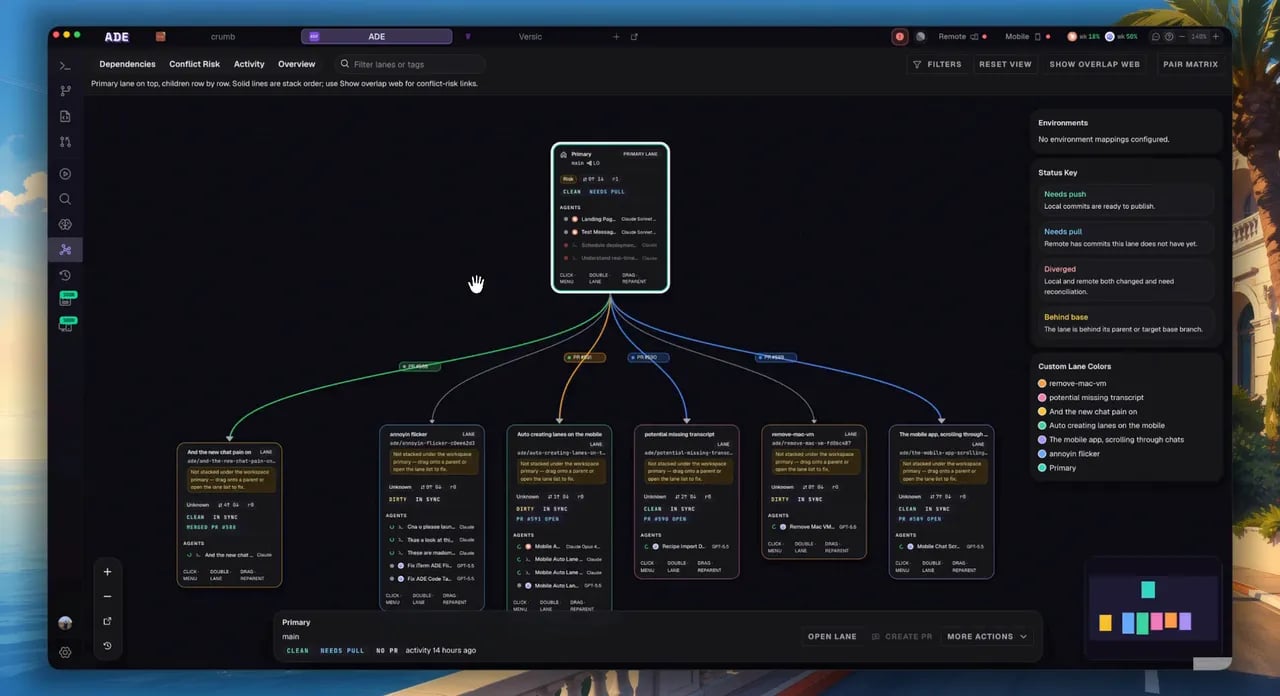
* Open the [graph](/tools/workspace-graph) when the stack gets hard to picture.
 ## Rebase propagation when the parent moves
When a parent lane's branch advances — new commits, or the base PR merges — its children are now behind. ADE notices and **suggests a rebase** on the affected child lanes, surfaced as an inline banner with **Rebase now**, **Snooze**, or **Hide**. Run it and ADE rebases the lane (and, by default, its descendants) onto the freshly advanced parent, in parent-to-child order so each child rebases onto an already-rebased parent.
Prefer not to click? Turn on **Settings → Lane Behavior → Auto-rebase child lanes** and ADE rebases children for you whenever a parent moves. If a rebase hits a conflict, the lane pauses and surfaces the conflicting files so you can resolve and continue.
You can also reorganize a stack after the fact: the manage dialog's stack section lets you pick a new parent lane (or override the base branch), and ADE rebases the lane onto the new base. It refuses moves that would create a cycle — you can't reparent a lane under one of its own descendants, and the primary lane can never become a child.
## When not to stack
Stack only genuinely dependent work. If two tasks can merge in either order, give them **sibling lanes** off your default branch instead — independent PRs are simpler to review and don't block each other. A stack is the right tool only when slice B literally builds on slice A's not-yet-merged changes.
The end-to-end review and merge flow for a stack.
See stack relationships, PR links, and merge order.
## Rebase propagation when the parent moves
When a parent lane's branch advances — new commits, or the base PR merges — its children are now behind. ADE notices and **suggests a rebase** on the affected child lanes, surfaced as an inline banner with **Rebase now**, **Snooze**, or **Hide**. Run it and ADE rebases the lane (and, by default, its descendants) onto the freshly advanced parent, in parent-to-child order so each child rebases onto an already-rebased parent.
Prefer not to click? Turn on **Settings → Lane Behavior → Auto-rebase child lanes** and ADE rebases children for you whenever a parent moves. If a rebase hits a conflict, the lane pauses and surfaces the conflicting files so you can resolve and continue.
You can also reorganize a stack after the fact: the manage dialog's stack section lets you pick a new parent lane (or override the base branch), and ADE rebases the lane onto the new base. It refuses moves that would create a cycle — you can't reparent a lane under one of its own descendants, and the primary lane can never become a child.
## When not to stack
Stack only genuinely dependent work. If two tasks can merge in either order, give them **sibling lanes** off your default branch instead — independent PRs are simpler to review and don't block each other. A stack is the right tool only when slice B literally builds on slice A's not-yet-merged changes.
The end-to-end review and merge flow for a stack.
See stack relationships, PR links, and merge order.